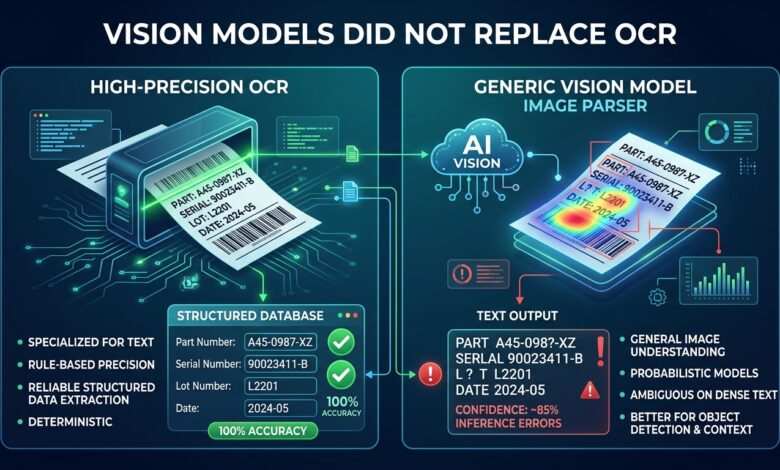
Key takeaway: Vision language models interpret; OCR transcribes. When exact characters and their positions matter, the older technology is still the correct one.
Where Each Excels
Traditional OCR — Tesseract, PaddleOCR, cloud document APIs — detects text regions and classifies characters. It returns exactly what is printed, with bounding boxes and per-character confidence.
A vision language model processes the image alongside a text prompt and generates an answer. It can respond to “what is the total on this invoice?” without any explicit layout parsing, and it handles unusual formats gracefully because it is reasoning rather than pattern matching.
| Requirement | OCR engine | Vision LM |
|---|---|---|
| Exact character fidelity | High | Variable |
| Bounding box coordinates | Native | Approximate or absent |
| Per-item confidence | Yes | No |
| Handles novel layouts | Poorly | Well |
| Answers questions about content | No | Yes |
| Cost per page | Very low | 10–100× higher |
| Latency | Milliseconds | Seconds |
| Deterministic | Yes | No |
The Failure Mode That Matters
A vision model reading a serial number, an account number or a monetary amount may produce something plausible rather than something correct. It might read 8 as 3, or normalise 1,024.50 to 1024.5, or silently correct what it judges to be a typo.
That behaviour is desirable when interpreting prose and unacceptable when transcribing an identifier. The model has no mechanism to signal “this character was ambiguous” — it simply emits its best guess with the same fluency as everything else.
OCR returns a confidence score per character. Low confidence routes to human review. That signal is the difference between a pipeline you can operate and one that fails silently.
Combining Them Properly
The effective architecture uses both, each for what it does well.
Run OCR first to obtain exact text with coordinates. Pass that text — not the raw image — to a language model for interpretation, classification and extraction of structured fields. Keep the OCR output as the authoritative record of what the document says.
This gives you an audit trail. When an extracted value is disputed, you can point at the coordinates on the page and the transcribed characters, rather than at a model’s assertion.
For genuinely difficult documents — handwriting, degraded scans, complex nested tables — the vision model earns its cost by handling what OCR cannot parse. Route selectively based on OCR confidence rather than sending everything to the expensive path.
Practical Guidance
Preprocessing still matters more than model choice for scanned input. Deskewing, denoising and correcting contrast improve OCR accuracy substantially and cost almost nothing.
Validate extracted fields against their expected shape. A date that does not parse, a total that does not equal the sum of line items, or an identifier failing a checksum are all detectable without any model.
The Bottom Line
Use OCR for transcription and coordinates, a language model for interpretation, and route to a vision model only where OCR confidence is low. Never rely on a generative model for characters that must be exact.