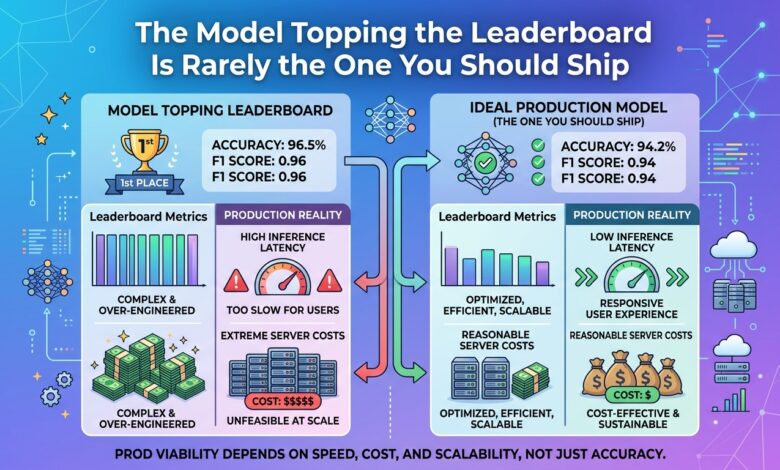
Key takeaway: Benchmark rank correlates weakly with performance on a specific production task. The only ranking that matters is the one you produce yourself against your own evaluation set.
Why the Leaderboard Misleads
A model ranking first on a general reasoning benchmark may be mediocre at extracting structured fields from invoices, or verbose when your product needs concise answers, or expensive relative to a smaller model that performs identically on your specific task.
This is not a flaw in the benchmark — it is measuring what it says it measures, which is general capability across a broad task distribution. Your application almost certainly needs a narrower capability, and narrow capability is precisely where general rankings predict least reliably.
What Differs Between General and Task-Specific Performance
| Factor | Why benchmarks miss it |
|---|---|
| Domain vocabulary | Benchmarks use general text, not your terminology |
| Output format compliance | General benchmarks rarely test strict schema adherence |
| Latency at your typical input length | Benchmarks often use short, standardised prompts |
| Behaviour on your edge cases | Your edge cases are not in any public benchmark |
| Cost at your actual token profile | Pricing interacts with your specific prompt and output length |
Output format compliance is an underappreciated gap. A model excelling at open-ended reasoning may perform worse than a smaller model at reliably producing valid structured output matching your exact schema, because that is a distinct skill the general benchmark does not isolate.
Building the Evaluation That Actually Predicts Your Outcome
The only reliable approach is constructing an evaluation set from your own real inputs and known-correct outputs, then running every model candidate against it under identical conditions.
Fifty to one hundred examples drawn from actual production traffic — or realistic synthetic equivalents if no traffic exists yet — outperforms any public benchmark for predicting your specific outcome, because it is measuring exactly the thing you need measured rather than a proxy for it.
Include the failure cases you already know about. If a previous model version struggled with a particular input pattern, that pattern belongs in the evaluation set permanently, so every future model comparison automatically checks whether the new candidate handles it.
Running the Comparison Fairly
Test every candidate with the same prompt, the same temperature setting, and the same post-processing. A common mistake is optimising the prompt for one model during initial development, then comparing an unoptimised prompt against a new candidate — that comparison favours whichever model happened to receive more tuning effort rather than reflecting genuine capability difference.
Measure cost and latency alongside accuracy, on your actual token profile rather than a standardised short prompt. A model that is marginally more accurate and meaningfully slower or more expensive may not be the better choice depending on your product’s tolerance for each.
Revisiting the Decision
Model rankings change frequently as providers release new versions. Re-run your evaluation set periodically against new releases rather than assuming last quarter’s choice remains optimal — the evaluation set is the reusable asset here, and re-running it costs little once built.
The Bottom Line
Build an evaluation set from your own real inputs and known failure cases, and use it as the sole basis for model selection. Compare candidates under identical prompting and post-processing conditions, measure cost and latency on your actual usage profile, and re-run the comparison whenever new model versions appear.