LLMs & Generative AI
-

Getting Reliable JSON From Language Models: What Actually Works
Asking a model politely for JSON produces valid JSON most of the time, which is the worst possible failure rate.…
Read More » -
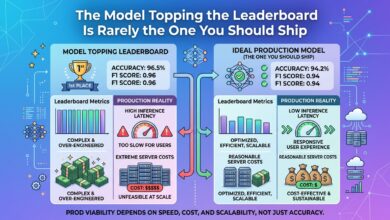
The Model Topping the Leaderboard Is Rarely the One You Should Ship
Public benchmarks measure general capability on tasks chosen by the benchmark's authors, which frequently have little overlap with what your…
Read More » -
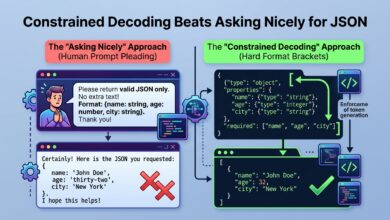
Constrained Decoding Beats Asking Nicely for JSON
Prompting for valid JSON gets you valid JSON most of the time. Constraining the decoder to a grammar gets it…
Read More » -
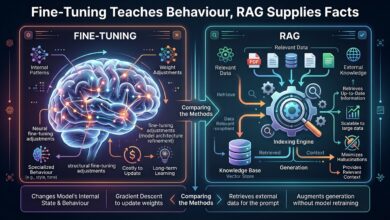
Fine-Tuning Teaches Behaviour, RAG Supplies Facts
Teams reach for fine-tuning to inject knowledge and get an expensive model that hallucinates confidently in the right format.
Read More » -

Changing Your Embedding Model Invalidates Every Vector You Stored
Vectors from two different models occupy incompatible spaces. Mixing them silently produces nonsense similarity scores with no error anywhere.
Read More » -

Detecting Hallucinations Without Another Model
Several cheap deterministic checks catch a substantial fraction of fabricated output before it reaches a user, and none of them…
Read More » -
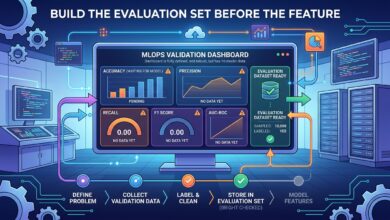
Build the Evaluation Set Before the Feature
Without a fixed set of examples and expected outcomes, every prompt change is a guess and every model upgrade is…
Read More » -

Temperature Is Not a Creativity Dial
Temperature reshapes a probability distribution. Understanding what it actually does explains why raising it produces incoherence rather than imagination.
Read More » -

Context Windows Got Huge. Your Prompts Should Not Have.
Million-token context windows changed what is possible, not what is advisable. Position effects, cost scaling, and attention dilution mean more…
Read More » -

Agents Fail Because Their Tools Were Designed for Humans
A tool description written like internal API documentation gives the model no basis for deciding when to call it or…
Read More »