Key takeaway: Automation bias means reviewers accept system output at high rates regardless of quality. Oversight is a property of the workflow design, not of having a person present.
Rubber-Stamping Is the Default Outcome
Studies of automated decision support consistently find that reviewers agree with system recommendations far more often than independent judgement would predict. The effect strengthens when the reviewer is under time pressure, when the system is usually right, and when disagreeing requires extra work.
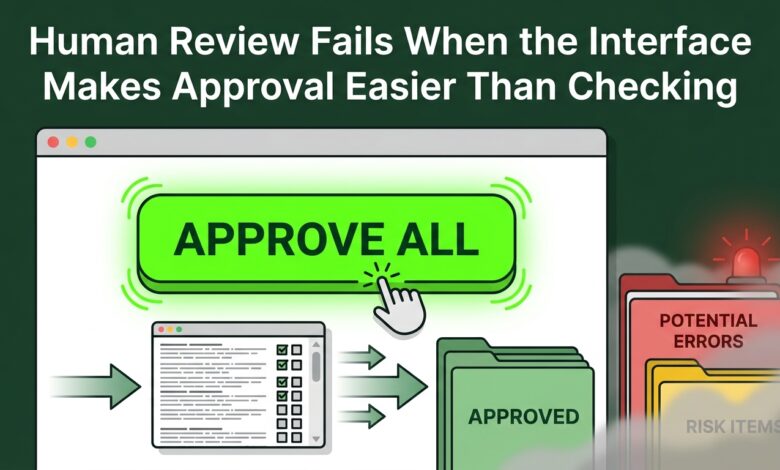
A workflow where the model proposes and a person clicks approve does not produce meaningful oversight. It produces a documented approval that satisfies a policy requirement while adding no error detection.
What Makes Review Real
Give the reviewer the evidence, not the conclusion. Showing “recommendation: reject” invites agreement. Showing the specific factors, the retrieved documents and the values that drove the outcome enables evaluation.
Do not display confidence as a substitute for reasoning. A high confidence score suppresses scrutiny without justifying it, and model confidence correlates poorly with correctness.
Make disagreement as cheap as agreement. If approving is one click and overriding requires a written justification in a separate form, the interface has chosen the outcome. Symmetric effort is a design requirement.
Sample for independent judgement. Route a fraction of cases to a reviewer who sees the inputs without the model’s output. Comparing their decisions to the model’s is the only way to measure whether review is adding anything.
Budget realistic time. A reviewer with ninety seconds per case cannot evaluate anything substantive. If throughput targets assume approval, that is what you will get.
Choosing the Oversight Model
| Pattern | When appropriate |
|---|---|
| Human decides, model advises | High stakes, irreversible outcomes |
| Model decides, human reviews all | Moderate stakes, adequate capacity |
| Model decides, human reviews sampled | High volume, measurable error cost |
| Model decides, human handles exceptions | Low stakes, reliable confidence signal |
| Full automation with audit | Low stakes, reversible, monitored |
Reviewing everything is often worse than reviewing a sample well. Full review at high volume forces shallow attention across all cases; sampling concentrates real scrutiny where it can function, and combines with monitoring to catch systematic problems.
The exception-handling pattern depends entirely on whether the confidence signal is trustworthy. If it is not calibrated, routing by confidence sends the wrong cases to humans.
Measuring Whether It Works
Override rate is the primary indicator. A rate near zero means either the model is excellent or review is theatre, and those two are distinguishable only through blind sampling.
Track outcomes on overridden cases too. If reviewers overrule the model and are usually wrong, the problem is reviewer calibration rather than model quality — a different fix entirely.
The Bottom Line
Design the interface so that checking is as easy as approving, show evidence rather than conclusions, and measure override rate against blind independent review. A human in the loop who cannot realistically disagree is documentation, not oversight.