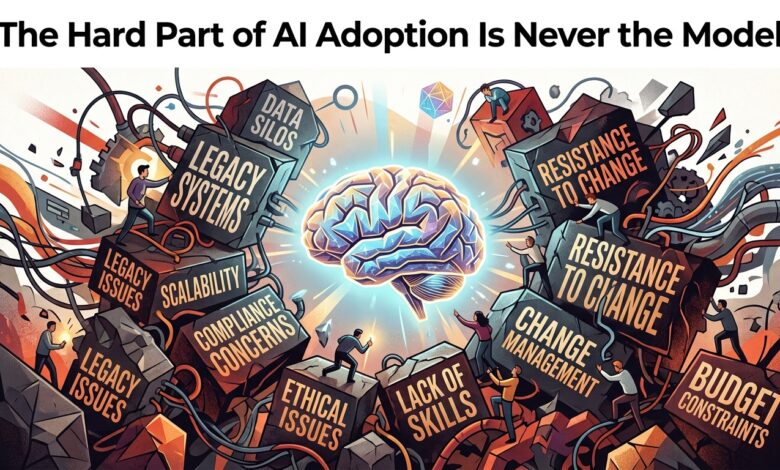
Key takeaway: Adoption depends on whether the tool reduces effort inside an existing workflow. A capability that requires people to change how they work will lose to the status quo regardless of how good it is.
The Pattern of Quiet Abandonment
A team ships an AI feature. Usage spikes during the announcement week, declines over the next month, and settles near zero.
Nobody complained. The output quality was acceptable. What happened is that using it required opening a separate interface, copying context into it, reading the result, and transferring the output back into the system where the work actually lives.
That friction exceeded the time saved. Not by much — perhaps two minutes against three saved — but the calculation was close enough that habit won, and habit always wins a close contest.
Where the Tool Has to Live
The single strongest predictor of adoption is whether the capability appears inside the tool people already have open.
| Placement | Adoption |
|---|---|
| Separate application requiring context transfer | Very low |
| Browser extension over the existing tool | Moderate |
| Inside the existing tool, requires a click | Good |
| Inside the existing tool, appears automatically | High |
A draft that appears in the ticket the agent is already reading gets used. The same draft available by opening another tab does not.
This is why integration work — which looks like plumbing and gets scheduled last — determines whether the project succeeds. The model was never the constraint.
The Trust Question
People do not use output they cannot verify, and verification cost is part of the effort calculation.
Showing the reasoning or the source makes verification fast. A summary with citations to the underlying documents can be checked in seconds. A summary with no provenance requires reading the source material, which eliminates the time saving entirely.
Early accuracy matters disproportionately for the same reason. A tool that is wrong in a visible way during someone’s first three uses loses that person permanently, because they now verify everything and the tool provides no benefit. Launching narrow and accurate beats launching broad and inconsistent.
Involving the People Who Do the Work
The most common design error is building for an imagined workflow rather than the observed one. Sit with the people doing the task and watch what they actually do — the real process invariably differs from the documented one, and the friction points are rarely where management assumes.
Ask what part of the job they would most like to stop doing. That answer identifies where enthusiasm exists, and enthusiasm carries a tool through its rough early period.
Avoid framing that implies replacement. A tool positioned as doing someone’s job invites resistance; the same tool positioned as removing the tedious portion invites use. This is not merely presentation — it should also be true, and if it is not, the resistance is a rational response.
Measuring Adoption Honestly
Track weekly active users as a proportion of the eligible population, and repeat usage rather than first-time usage. A tool with high trial and low return has a fit problem, not an awareness problem, and more training will not fix it.
Then ask the people who stopped using it why. That answer is more informative than any usage dashboard and is the one nobody collects.
The Bottom Line
Put the capability inside the tool people already use, show sources so verification is fast, launch narrow enough to be accurate, and observe the real workflow before designing for it. Measure repeat usage and interview the people who abandoned it.