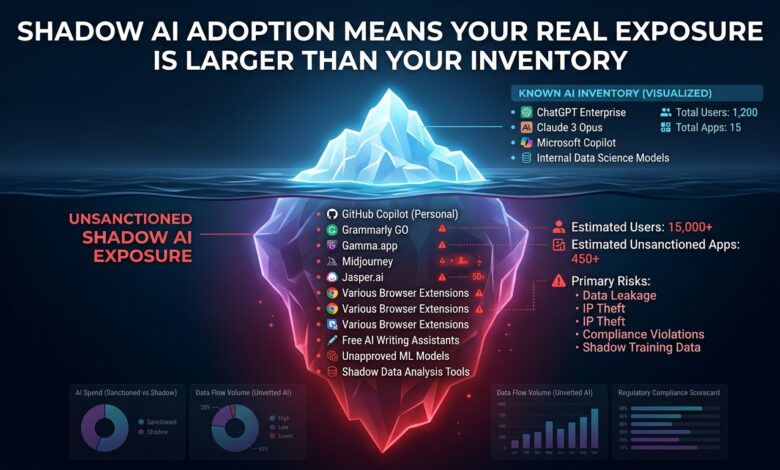
Key takeaway: The gap between an organisation’s official AI inventory and its actual AI usage is where the real risk concentrates. Closing it requires making the sanctioned path easier than the unsanctioned one, not just prohibiting the latter.
How the Gap Forms
An employee finds that pasting a document into a public chat interface produces a useful summary faster than any internal tool offers. They do this repeatedly, for increasingly sensitive documents, without any deliberate decision to bypass policy — it is simply the fastest available path to finishing the task.
Multiply this across a large organisation and the result is unmeasured, ungoverned data flow to external services, discovered only when someone asks directly or when a security review happens to notice unusual traffic patterns. Surveys consistently find substantially more employees using external AI tools for work tasks than official usage records would suggest, which is the gap made visible.
Why Prohibition Alone Does Not Close It
A policy stating that external AI tools are forbidden addresses the written record and not the underlying behaviour, unless the sanctioned alternative is genuinely competitive with what the policy prohibits.
| Response | Effect on the gap |
|---|---|
| Prohibit external tools, no alternative provided | Gap persists, moves underground |
| Prohibit and block access technically | Gap persists via personal devices |
| Provide an approved tool that is worse | Gap narrows partially |
| Provide an approved tool that is genuinely competitive | Gap narrows substantially |
Technical blocking on managed devices reliably pushes the behaviour to personal devices and personal accounts, which is worse for governance because it removes even the limited visibility a managed device provided.
What Actually Closes the Gap
Provide an internal or vetted external tool with an enterprise data agreement, integrated into where people already work, that is at least as fast and useful as the alternative it replaces. This is the same adoption principle that applies to any AI feature — placement and friction determine usage more than capability does.
Pair that with clear, specific guidance about what categories of data may go where, rather than a blanket prohibition that people will route around when it conflicts with getting their job done under deadline pressure. Specific guidance that acknowledges real workflows gets followed; blanket prohibition that ignores them gets quietly ignored in return.
Measuring the Actual Gap
Network-level detection of traffic to known AI service domains gives an approximate measure of unsanctioned usage, though encrypted traffic and personal devices limit its completeness. Anonymous surveys asking directly about tool usage, framed as understanding needs rather than catching violations, tend to produce more honest and complete answers than any technical detection method.
The purpose of measuring is not enforcement — it is understanding which needs the sanctioned tooling is failing to meet, which is the actual lever available to close the gap.
Building the Inventory Honestly
Any AI governance programme has to start from the assumption that actual usage exceeds the official inventory, and treat closing that gap as an ongoing process rather than a one-time audit. An inventory taken once and never revisited is stale within months, because new tools and new use cases appear continuously.
The Bottom Line
Assume unsanctioned AI usage exceeds what any policy document accounts for, and close the gap by making the sanctioned option genuinely competitive rather than by prohibition alone. Measure the gap through anonymous surveys and network signals to understand what need is going unmet, and treat governance as continuous rather than a single audit.